
Product
·
How to choose a legal research system

Something has changed in the last year. Firms that renewed the same database contract for a decade without reading it are suddenly running evaluations. Managing partners who were happy to leave research tooling to the library are now sitting in demos. Procurement committees that met once a year are meeting monthly.
The trigger is not that the old tools got worse. They didn't. It is that almost every lawyer has now seen what a good model does with a legal question, usually by accident, usually on a Sunday evening, and the contrast is hard to unsee. The tool the firm pays for retrieves documents. The tool the associate is quietly using at home reasons about them.
So the instinct driving this wave is correct. There must be a better way to do this now, and there is. The difficulty is that the market became confusing at exactly the moment everyone started paying attention. At least four different things are being sold under the same phrase, and they fail in different ways.
I work at Pandektes. My aim here is to describe the approaches honestly because a firm that understands the landscape makes a better customer than one that has been sold to.
Why the legacy tools feel outdated
For decades, legal research companies built their business on one thing: owning the largest collection of legal documents.
That made perfect sense. Collecting legislation, case law, and legal commentary was expensive, time-consuming, and almost impossible for competitors to replicate. The database itself was the competitive advantage.
But having the biggest library doesn't automatically mean it's the best place to read. When nobody else has access to the same information, your search only has to be good enough. Lawyers adapt. They learn the quirks of the system, rewrite searches again and again, and spend time digging through results that aren't relevant.
You can even see this in how many legal databases are priced. AI-based search is often sold as an additional feature instead of simply replacing the old search. That reveals something important: search quality is treated as an optional upgrade. But the world has changed.
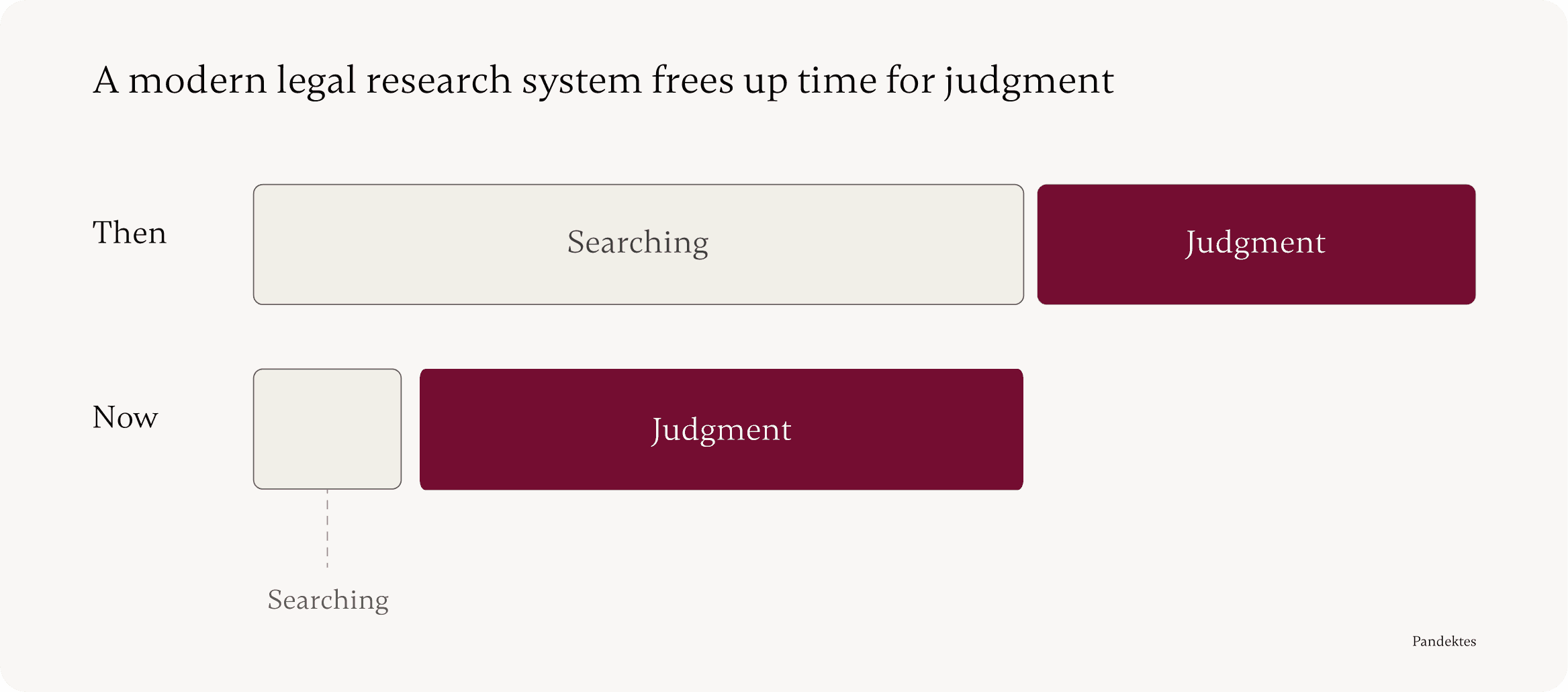
Building a comprehensive legal database is no longer the impossible task it once was. Once multiple companies have enough high-quality legal material, the competition stops being about who owns more documents. It becomes about who helps lawyers find the right one and make the best judgement.
A document that exists somewhere in a database, but never appears when you need it, is effectively the same as a document that isn't there at all. For the lawyer researching a case, undiscoverable information has no value. In other words, retrieval determines the value of the corpus.
With the right legal research tool, lawyers stop wasting time rewriting searches, opening irrelevant cases, and checking whether they've found the most recent version of the law.
The four tools you will meet
The incumbent with an AI layer
As explained, these have the corpus, and nobody should be casual about that. The problem is that the intelligence has been added to a product whose search index, data model and pricing were designed around a different question. You can see the seams. The chat sits beside the search rather than underneath it. Answers point at documents rather than passages. And the commercial model, priced per module and per seat and per jurisdiction, quietly punishes the exploratory behaviour that makes up high-stakes legal research. If it costs money to look, people stop looking.
The general-purpose model
The largest gap between how good it feels and how good it is. It has no verified corpus. It will hallucinate a citation shaped exactly like a real one. It does not know whether the provision was amended in 2024, and it will not tell you that it doesn't know. There is also a confidentiality problem that most firms have noticed and few have addressed, because a lawyer pasting client facts into a consumer product has not selected a service provider the e.g., Bundesrechtsanwaltsordnung (BRAO) would recognise.
Worth saying plainly: this is probably already happening inside your firm. You won't be able to prohibit it without something you can give people instead.
The document layer
Tools that work over your own material: contracts, the case file, the data room. They are good at what they do. But they treat the law itself as somebody else's problem. They will tell you what your contract says. They will not tell you whether the clause survives contact with the case law. That is half the analysis, and the more expendable half, because the client's own documents were never the hard part.
Building it yourself
Some firms might consider to build their own systems, while underestimating the effort it takes to build something reliable in this domain. Consolidating statutes to the correct date. Attaching preparatory works at the level of the individual section, where a lawyer actually needs them, rather than as a PDF bolted to the act. Linking a first-instance judgment to the appeal that reversed it. Keeping all of it current, forever, while the legislature keeps working.
Each problem is manageable on its own. Together, they require a permanent team and infrastructure that few firms want to build or maintain themselves. Firms that start often end up with a prototype, an ongoing maintenance burden, and a partner who has accidentally acquired a new hobby.
At the very largest firms, building this in-house may be possible. They may have the engineering teams, data infrastructure, and budget to take it on. Although even that is yet to be seen. For all mid-sized and smaller firms, however, it is not a realistic project.
What the fifth category looks like
Notice what none of the four do. The incumbent has the law but not the reasoning. The general model has the reasoning but not the law. The document layer has your files but not the law. Building it yourself gets you a small version of all three, badly, at great expense.
The category that actually answers the 2026 question is a research platform built from the corpus up, with the reasoning underneath rather than beside it.

Look out for the following five properties when evaluating system. Each one gives you a test you can run in a demo.
The first is that verification is the product. An answer a lawyer cannot check is worth less than no answer at all, because no answer costs you an afternoon and a wrong answer you believed costs you a client. So the metric is not answer quality. It is the cost of doubt. Ask a question you already know the answer to, start a timer, and try to get from the claim to the sentence in the source that supports it. Count the clicks. The variation between products is enormous, and it tells you whether the thing was built by people who have had to defend a memo.
The second is that the platform impresses with superior data quality and coverage, not the model. Almost every vendor in this market licenses intelligence from the same handful of labs, and the gap between the best and second-best model has a shelf life measured in months. What does not commoditise is the patient, unglamorous data work underneath. So ask what a vendor does with data rather than which model it runs. Pick a case you know went through several instances and ask to see its path.
The third is that the law and your own documents belong in one place. Legal analysis has always happened in two worlds, with case law and legislation in an external database and the client's file in an internal one, and the lawyer serving as the integration layer between them, holding the connection in their head and hoping not to drop it.
The fourth is that some constraints are conditions of entry rather than preferences. Ask where the data physically sits, whether row-level-security (RLS) is provided, and if BRAO, DSGVO & ISO requirements are met.
Last but not least, check for support quality. For decades, incumbents didn't need great support because customers had nowhere else to go. The irony is that law firms respond to their own clients within hours, even on weekends. Yet they rely on vendors that take days. The easiest way to test this is by sending them a real question and measure how long it takes to get an answer.
Where we stand
Pandektes was founded to be the fifth system, so I will be specific rather than vague.
Every answer resolves to a cited source, because we assumed from the start that a lawyer would want to check. The assistant reasons according to legal method, with agents that understand the hierarchy of sources, rather than treating a legal question as a general one.
The corpus is where most of our years have gone. More than two million decisions. Statutes consolidated and current, with preparatory works attached at section level and links to the EU directives they implement. Public case law and administrative decisions pulled out of a dozen scattered databases into one searchable place. Instance timelines, so you can follow a case from first instance to final judgment and see exactly where it turned. Firms can load their own proprietary case law alongside all of it, which means answers from sources no competitor has.
Matrix exists because of the third property. It puts case law, legislation and your own documents in a single workspace, so thousands of decisions can be analysed against your own file without switching systems. The Word add-in exists for the same reason. Research should arrive where the writing happens.
On the fourth, we hold ourselves to the highest security standards in the market. The part worth noting is when. We built to that bar before any client asked for it, when nothing on the table justified the cost.
What I would actually do
Don't take my word for any of this. The instinct that brought you here, that the old way cannot still be the best way in 2026, is right. The mistake would be to act on it quickly.
Work out which category each potential vendor on your list actually belongs to, regardless of what the website says. Then run the tests.
- Jerrit


